US Time Zones Map
This US time zones map colors each state by its time zone. The 50 states use six zones, from Eastern Time (UTC−5) on the Atlantic coast to Hawaii-Aleutian Time (UTC−10) in the Pacific, and 14 states are split between two zones.
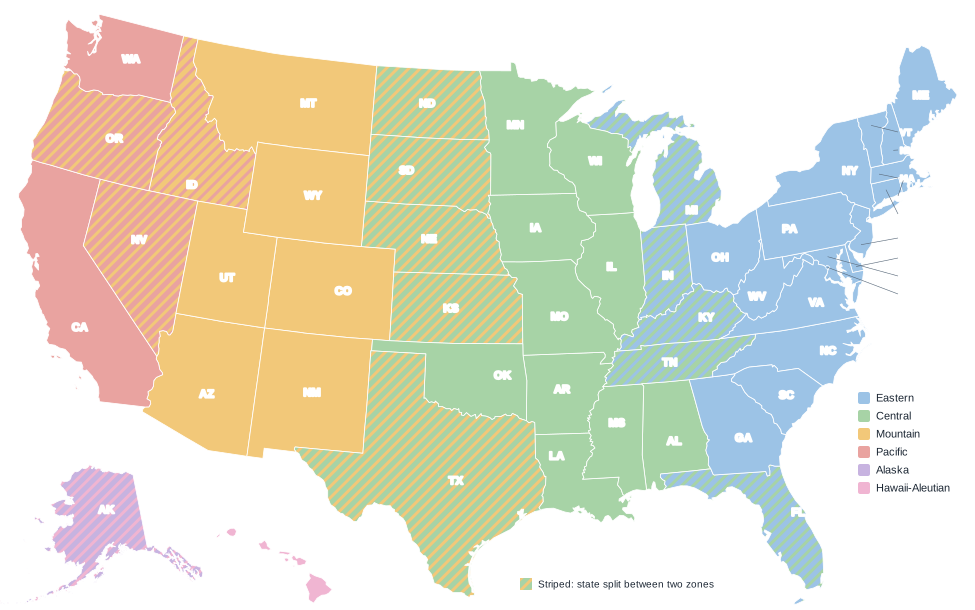
Each state is colored by its main time zone. States split between two zones are striped on the static map and list both zones on hover on the interactive map; the zone boundaries inside split states are not drawn.
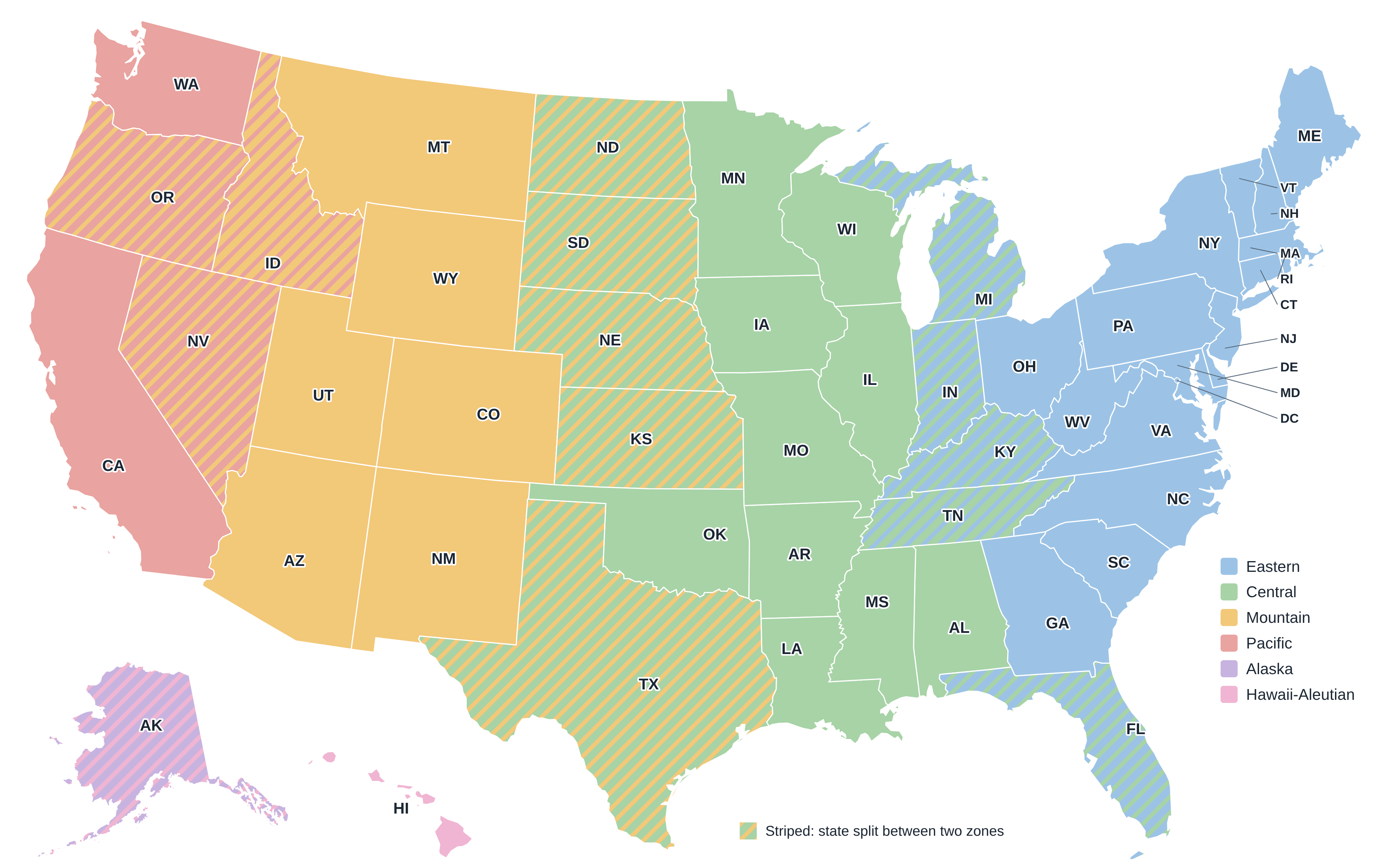
Download the US time zone map
Free to print for home and classroom use: PDF for US Letter paper, PNG for slides, SVG for editing.
The six US time zones
Offsets are from Coordinated Universal Time (UTC). “Daylight” is the offset while daylight saving time is in effect, from March to November.
| Time zone | Standard time | Daylight time | Example cities |
|---|---|---|---|
| Eastern (ET) | UTC−5 (EST) | UTC−4 (EDT) | New York, Atlanta, Miami |
| Central (CT) | UTC−6 (CST) | UTC−5 (CDT) | Chicago, Houston, Nashville |
| Mountain (MT) | UTC−7 (MST) | UTC−6 (MDT) | Denver, Salt Lake City; Phoenix stays on UTC−7 all year |
| Pacific (PT) | UTC−8 (PST) | UTC−7 (PDT) | Los Angeles, Seattle, Las Vegas |
| Alaska (AKT) | UTC−9 (AKST) | UTC−8 (AKDT) | Anchorage |
| Hawaii-Aleutian | UTC−10 (HST) | None in Hawaii; UTC−9 in the western Aleutians | Honolulu |
Each zone is one hour behind the zone to its east. When it is noon Eastern Standard Time in New York, it is 11 a.m. in Chicago, 10 a.m. in Denver, 9 a.m. in Los Angeles, 8 a.m. in Anchorage and 7 a.m. in Honolulu. In summer Honolulu falls one more hour behind most of the mainland, because Hawaii does not move its clocks.
Daylight saving time rules
- Starts: 2 a.m. local time on the second Sunday in March, when clocks move forward one hour (next: March 14, 2027).
- Ends: 2 a.m. local time on the first Sunday in November, when clocks move back one hour (next: November 1, 2026).
- Exceptions: Hawaii and most of Arizona stay on standard time all year. In Arizona, the Navajo Nation observes daylight saving time; the Hopi Reservation, which lies inside it, does not.
- Territories: Puerto Rico, the U.S. Virgin Islands, American Samoa, Guam and the Northern Mariana Islands do not observe daylight saving time.
Because Arizona does not change its clocks, Phoenix is on the same time as Denver in winter and the same time as Los Angeles in summer.
States split between two time zones
Fourteen states have more than one time zone. In each, the boundary often follows county lines, so a short drive can change the clock by an hour.
- Alaska (Alaska / Hawaii-Aleutian): Alaska Time; the western Aleutian Islands use Hawaii-Aleutian Time.
- Florida (Eastern / Central): Central Time in most of the Panhandle west of the Apalachicola River.
- Idaho (Mountain / Pacific): Pacific Time in the northern Panhandle.
- Indiana (Eastern / Central): Central Time in 12 counties in the northwest (near Chicago) and southwest (near Evansville).
- Kansas (Central / Mountain): Mountain Time in four western counties.
- Kentucky (Eastern / Central): Roughly the western half is Central Time.
- Michigan (Eastern / Central): Central Time in four Upper Peninsula counties bordering Wisconsin.
- Nebraska (Central / Mountain): Mountain Time in the western Panhandle.
- Nevada (Pacific / Mountain): West Wendover uses Mountain Time.
- North Dakota (Central / Mountain): Mountain Time in the southwest.
- Oregon (Pacific / Mountain): Mountain Time in most of Malheur County.
- South Dakota (Central / Mountain): Mountain Time west of the Missouri River.
- Tennessee (Central / Eastern): East Tennessee (Knoxville, Chattanooga) is Eastern Time.
- Texas (Central / Mountain): Mountain Time in El Paso and Hudspeth counties.
Time zones of the US territories
- Atlantic Time (UTC−4): Puerto Rico and the U.S. Virgin Islands, one hour ahead of Eastern Standard Time.
- Samoa Time (UTC−11): American Samoa, six hours behind Eastern Standard Time.
- Chamorro Time (UTC+10): Guam and the Northern Mariana Islands, west of the International Date Line and 15 hours ahead of Eastern Standard Time.
Time zone by state
All 50 states with their time zones. Click a column heading to sort.
| State | Time zone(s) | Note |
|---|---|---|
| Alabama | Central | — |
| Alaska | Alaska / Hawaii-Aleutian | Alaska Time; the western Aleutian Islands use Hawaii-Aleutian Time |
| Arizona | Mountain | Mountain Standard Time all year (no daylight saving time), except the Navajo Nation, which observes DST |
| Arkansas | Central | — |
| California | Pacific | — |
| Colorado | Mountain | — |
| Connecticut | Eastern | — |
| Delaware | Eastern | — |
| Florida | Eastern / Central | Central Time in most of the Panhandle west of the Apalachicola River |
| Georgia | Eastern | — |
| Hawaii | Hawaii-Aleutian | Hawaii-Aleutian Standard Time all year (no daylight saving time) |
| Idaho | Mountain / Pacific | Pacific Time in the northern Panhandle |
| Illinois | Central | — |
| Indiana | Eastern / Central | Central Time in 12 counties in the northwest (near Chicago) and southwest (near Evansville) |
| Iowa | Central | — |
| Kansas | Central / Mountain | Mountain Time in four western counties |
| Kentucky | Eastern / Central | Roughly the western half is Central Time |
| Louisiana | Central | — |
| Maine | Eastern | — |
| Maryland | Eastern | — |
| Massachusetts | Eastern | — |
| Michigan | Eastern / Central | Central Time in four Upper Peninsula counties bordering Wisconsin |
| Minnesota | Central | — |
| Mississippi | Central | — |
| Missouri | Central | — |
| Montana | Mountain | — |
| Nebraska | Central / Mountain | Mountain Time in the western Panhandle |
| Nevada | Pacific / Mountain | West Wendover uses Mountain Time |
| New Hampshire | Eastern | — |
| New Jersey | Eastern | — |
| New Mexico | Mountain | — |
| New York | Eastern | — |
| North Carolina | Eastern | — |
| North Dakota | Central / Mountain | Mountain Time in the southwest |
| Ohio | Eastern | — |
| Oklahoma | Central | — |
| Oregon | Pacific / Mountain | Mountain Time in most of Malheur County |
| Pennsylvania | Eastern | — |
| Rhode Island | Eastern | — |
| South Carolina | Eastern | — |
| South Dakota | Central / Mountain | Mountain Time west of the Missouri River |
| Tennessee | Central / Eastern | East Tennessee (Knoxville, Chattanooga) is Eastern Time |
| Texas | Central / Mountain | Mountain Time in El Paso and Hudspeth counties |
| Utah | Mountain | — |
| Vermont | Eastern | — |
| Virginia | Eastern | — |
| Washington | Pacific | — |
| West Virginia | Eastern | — |
| Wisconsin | Central | — |
| Wyoming | Mountain | — |
See the US regions map for how these states group into the Northeast, Midwest, South and West, or the labeled US map to check state names.
Frequently asked questions
How many time zones does the US have?
The 50 states use six: Eastern, Central, Mountain, Pacific, Alaska and Hawaii-Aleutian. Federal law defines nine standard zones in total, adding Atlantic, Samoa and Chamorro Time for the territories.
Which states have two time zones?
Fourteen: Alaska, Florida, Idaho, Indiana, Kansas, Kentucky, Michigan, Nebraska, Nevada, North Dakota, Oregon, South Dakota, Tennessee and Texas.
Does Arizona change its clocks?
No. Arizona stays on Mountain Standard Time (UTC−7) all year. The exception is the Navajo Nation in the northeast, which observes daylight saving time.
Which time zone has the most states?
Eastern Time. Seventeen states lie entirely in the Eastern zone, compared with ten entirely in Central, six in Mountain, two in Pacific and one (Hawaii) in Hawaii-Aleutian; the other 14 are split.
Sources: U.S. Department of Transportation (which oversees US time zones), National Institute of Standards and Technology (NIST), U.S. Census Bureau (boundaries). Last reviewed October 2026.